Interest Rate Risk and Return
Go to Fixed Income
Topics
Table of Contents
Introduction
This learning module covers:
- Sources of return from investing in a fixed rate bond
- How investors are exposed to different interest rate risk if the same bond is held for different time periods
- Macaulay duration
Sources of Return from Investing in a Fixed-Rate Bond
The total return is the future value of reinvested coupon interest payments and the sale price (or redemption of principal if the bond is held to maturity). The horizon yield (or holding period rate of return) is the internal rate of return between the total return and the purchase price of the bond.
Total Return on a Bond = Reinvested Coupon Interest Payments + Sale/Redemption of Principal at Maturity
A bond investor has three sources of return:
- Receiving the full coupon and principal payments on the scheduled dates.
- Reinvesting the interest payments. This is also known as interest-on-interest.
- Potential capital gain or loss on sale of the bond, if the bond is sold before maturity date.
Now, we will look at a series of examples that demonstrate the effect on two investors’ realized rate of returns when one of these variable changes: time horizon, interest rate at which the coupons are reinvested, and market discount rates at the time of purchase and at the time of sale.
Total return on a bond that is held until maturity
A “buy-and-hold” investor purchases a 5-year, 10% annual coupon payment bond at 92.79 per 100 of par value and holds it until maturity. Calculate the total return on the bond.
Hence, r = 12%. This is the yield to maturity at the time of purchase.
However, this holds good only if all of the following three conditions are true:
- The bond is held to maturity.
- The coupon and final principal payments are made on time (no default or delay).
- The coupon payments are reinvested at the same rate of interest.
To calculate the total return on the bond, we first need to calculate the interest earned when coupon payments are reinvested.
Coupon Reinvestment:
- The investor receives 5 coupon payments of 10 (per 100 of par value) for a total of 50, plus the redemption of principal (100) at maturity. The investor has the opportunity to reinvest the cash flows. If the coupon payments are reinvested at 12% (i.e., yield to maturity), the future value of the coupons on the bond’s maturity date is 63.53 per 100 of par value. $$\sum_{i=0}^4 \left(10 \times (1.12)^i\right) =63.53$$
- The first coupon payment of 10 is reinvested at 12% for 4 years until maturity, the second is reinvested for 3 years, and so on. The future value of the annuity is -63.53.
- The amount in excess of the coupons, 13.53 (= 63.53 – 50), is the
interest-on-interestgain from compounding. - The investor’s total return is 163.53, the sum of the reinvested coupons (63.53) and the redemption of principal at maturity (100).
The realized rate of return is 12%. $$92.79= \frac{163.53}{(1+r)^5} ;;;;;r=12%$$
Total return on a bond that is sold before maturity
Investor who buys the same 5-year, 10% annual coupon payment bond but sells the bond after three years. Assuming that the coupon payments are reinvested at 12% for three years, calculate the total return on the bond.
Solution: The future value of the reinvested coupons is 33.74 per 100 of par value.
The interest-on-interest gain from compounding is 3.74 (= 33.74 – 30). After three years, when the bond is sold, it has two years remaining until maturity. If the yield to maturity remains 12%, then the sale price of the bond is 96.62.
The total return is 130.36 (= 33.74 + 96.62) and the realized rate of return is 12%.
This r is called the horizon yield, the internal rate of return between the total return and the purchase price of the bond.
Horizon yield is equal to the original yield to maturity if:
- Coupon payments are reinvested at the same yield to maturity calculated at the time of purchase of the bond.
- There are no capital gains or losses when the bond is sold. It is sold at a price on the constant-yield price trajectory. We arrive at the price 96.62 by taking 12% as the constant yield for the remaining two years.
- If the yield is more than 12%, then losses occur.
- If the yield is less than 12%, then capital gains occur.
Constant-Yield Price Trajectory for a 5-year, 10% Annual Payment Bond
The price of the bond at different time periods for a yield of 12% is plotted in the graph below:
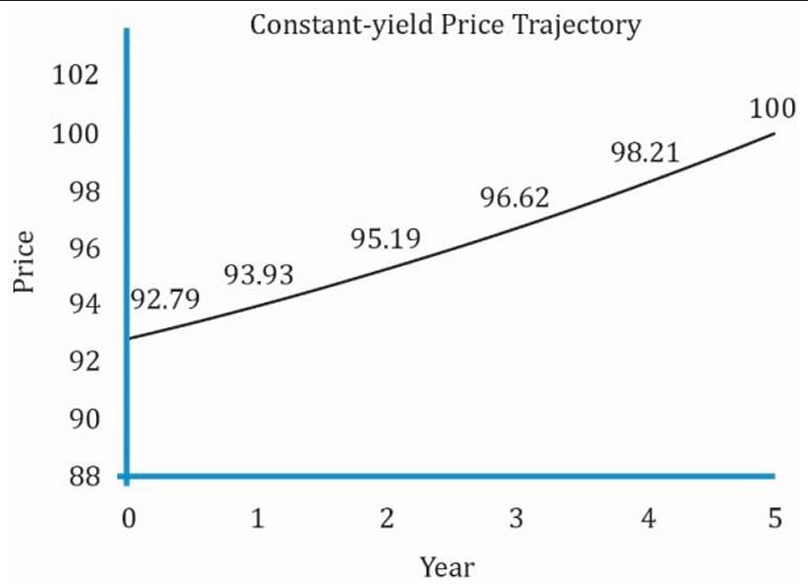
There will be a capital gain if the bond is sold at a price above the trajectory at any point in time during the bond’s life. This will happen if the yield is below 12%.
Remember a bond’s price and interest rates are inversely related.
Similarly, there will be a capital loss if the bond is sold at a price below the trajectory at any point in time during the bond’s life. This will happen if the yield is above 12%. Any point on the trajectory represents the carrying value of the bond at that time.
Realized return when interest rates go up and bond is held until maturity
The buy-and-hold investor purchases the same 5-year, 10% annual payment bond at 92.79. After the bond is purchased and before the first coupon is received, interest rates go up to 15%. Calculate the investor’s realized rate of return.
The total return is 167.42 (= 67.42 + 100). $$92.79= \frac{167.42}{(1+r)^5} ;→ r=12.53%$$
The investor’s realized rate of return is 12.53%.
Observation: Compared to Example 1 (12%), the realized return of this investor is higher because the coupons are reinvested at a higher rate. There is no capital gain or loss because the bond is held to maturity and the principal of 100 is redeemed.
Realized return when interest rates go up and bond is sold before maturity
The investor buys the same 5-year, 10% annual payment bond at 92.79 and sells it in three years. After the bond is purchased, interest rates go up to 15%. Calculate the investor’s realized gain.
The future value of the reinvested coupons at 15% after three years is -34.73.
The sale price of the bond after three years is 91.87.
The total return is 126.60 (= 34.73 + 91.87), resulting in a realized three-year horizon yield of 10.91%.
Observation: Compared to Example 2 with a similar time horizon (12%), the realized return to this investor is lower at 10.91% because there is a capital loss. Even though the coupons are reinvested at a higher rate, the capital loss is greater than the gain from reinvesting coupons.
Increase in the value of reinvested coupons = 0.99
Capital loss = 91.87 – 96.62 = -4.75
Capital gain or loss is always calculated relative to the carrying value at that point in time.
Realized return when interest rates go down
The buy-and-hold investor purchases the same 5-year, 10% annual payment bond at 92.79 and holds the security until it matures. After the bond is purchased, and before the first coupon is received, interest rates go down to 8%. Calculate the investor’s realized return.
The future value of reinvesting the coupon payments at 8% for 5 years is 58.67 per 100 of par value.
The total return is 158.67 (= 58.67 + 100), the sum of the future value of reinvested coupons and the redemption of par value.
The investor’s realized rate of return is 11.33%.
Observation: The realized return is lower than that in Example 1 (12%) because the coupons are reinvested at a lower rate of return. Since the bond is held to maturity, there is no capital gain or loss.
Decrease in the value of reinvested coupons = 58.67 – 63.53 = – 4.86
Realized return when interest rates go down
The second investor buys the same 5-year, 10% annual payment bond at 92.79 and sells it after three years. After the bond is purchased, interest rates go down to 8%. Calculate the investor’s realized return.
The future value of the reinvested coupons at 8% after three years is: $$\sum_{i=0}^2 \left(10 \times (1.08)^i\right) =32.46$$
This reduction in the future value of coupon reinvestments is offset by the higher sale price of the bond, which is 103.57 per 100 of par value.
The total return is 136.03 (= 32.46 + 103.57), resulting in a realized three-year horizon yield of 13.60%.
Observation: The realized return is greater than that of the investors in Examples 2 and 4 with a similar time horizon. It is primarily due to the capital gains.
Capital gain = 103.57 – 96.62 = 6.95
Decrease in the value of reinvested coupons = 32.46 – 33.74 = -1.28
As you can see, the capital gain is far greater than the decrease in the value of reinvested coupons.
Interest rate risk affects the realized rate of return for any bond investor in two ways: coupon reinvestment risk and market price risk. But what is interesting is that these are offsetting types of risk. Two investors with different time horizons will have different exposures to interest rate risk.
From the examples above, let us sum up what happens when interest rates go up or down:
When interest rates go up or down:
- Reinvestment income is directly proportional to interest rate movements. The value of reinvested coupons increases when the interest rate goes up.
- Bond price is inversely proportional to interest rate movements. Bond price decreases when the interest rate goes up.
When does coupon reinvestment risk matter?
- Coupon reinvestment risk matters when an investor has a long-term horizon. If the investor buys a bond and sells it before the first coupon payment, then this risk is irrelevant. But a buy-and-hold investor as in Examples 1, 3, and 5 has only coupon reinvestment risk.
When does market price risk matter?
- Market price risk matters when an investor has a short-term horizon relative to the time to maturity. If the investor buys a bond and sells it before the first coupon payment, then he is exposed to market price risk only. But a buy-and-hold investor such as those in Examples 1, 3, and 5 has only coupon reinvestment risk, and no market price risk.
Purchase price of the bond for various YTM
An investor buys a five-year, 10% annual coupon payment bond priced to yield 8%. The investor plans to sell the bond in three years once the third coupon payment is received. Calculate the purchase price for the bond and the horizon yield assuming that the coupon reinvestment rate after the bond purchase and the yield to maturity at the time of sale are (1) 7%, (2) 8%, and (3) 9%.
Solution: The purchase price is: $$\sum_{i=1}^5 \frac{10}{1.08^i} + \frac{100}{1.08^5} = 107.99 $$
| YTM at Sale | FV | PV | Total Return | Realized Return |
| ----------- | ------ | ------ | ------------ | --------------- |
| 7% | -32.15 | 105.42 | 137.57 | 8.4% |
| 8% | -32.46 | 103.57 | 136.03 | 8% |
| 9% | -32.78 | 101.76 | 134.54 | 7.6% |
Investment Horizon and Interest Rate Risk
The impact of a sudden change in yield on the price of a bond is of particular concern to short-term investors (price risk). Long-term investors will also be concerned about the impact of a change in yield on the reinvestment income (reinvestment risk). An investor who plans to hold the bond to maturity will only be concerned about reinvestment risk.
Consider another 10-year, 8% annual coupon bond priced at 85.5 and YTM of 10.4%. If the investment horizon is 10 years, the only concern is reinvestment risk.
- Interest rates go down → reinvestment income goes down.
- Interest rates go up → reinvestment income goes up.
- When the price of the bond goes up, it does not matter to the investor because at maturity he will simply receive par value.
- If the investment horizon is 4 years, then the major concern is price risk. In this case, the price effect dominates relative to the gain/loss from reinvestment of coupons.
- If the investment horizon is 7 years, the reinvestment risk and price risk offset each other. For this particular bond the Macaulay duration is 7 years.
Macaulay duration (explained in the next section) is the investment horizon for which coupon reinvestment risk and market price risk offset each other.
- The assumption is a one-time parallel shift in the yield curve.
- Investment horizon is different from the bond’s maturity. In this case, the maturity is 10 years while the horizon is 7 years.
The duration gap of a bond is defined as the Macaulay duration – investment horizon.
Duration Gap = Macaulay Duration – Investment Horizon
- If Macaulay duration < investment horizon, the duration gap is negative: coupon reinvestment risk dominates.
- If Macaulay duration = investment horizon, the duration gap is zero: coupon reinvestment risk offsets market price risk.
- If Macaulay duration > investment horizon, the duration gap is positive: market price risk dominates.
Duration gap and assessing interest rate risk
An investor plans to retire in 8 years. As part of the retirement portfolio, the investor buys a newly issued, 10-year, 6% annual coupon payment bond. The bond is purchased at par value, so its yield to maturity is 6.00% stated as an effective annual rate. The bond’s Macaulay duration is 7.8016.
- Calculate the duration gap at the time of purchase.
- Does this bond at purchase entail the risk of higher or lower interest rates? Interest rate risk here means an immediate, one-time, parallel yield curve shift.
Solution to 1: Given an investment horizon of 8 years, the duration gap for this bond at purchase is negative: 7.8016 – 8 = -0.1984
Solution to 2: A negative duration gap entails the risk of lower interest rates. To be precise, the risk is an immediate, one-time, parallel, downward yield curve shift because the coupon reinvestment risk dominates market price risk. The loss from reinvesting coupons at a rate lower than 6% is larger than the gain from selling the bond at a price above the constant-yield price trajectory.
Macaulay Duration
Macaulay duration is a weighted average of the time to receipt of the bond’s promised payments, where the weights are the shares of the full price that correspond to each of the bond’s promised future payments.
Let us consider a 10-year, 8% annual payment bond. To determine the Macaulay duration, we calculate the present value of each cash flow, multiply by weight and add, as shown in the below exhibit.
| Period | Cash Flow | PV | Weight | Period x Weight |
| ------ | --------- | --------- | ------- | --------------- |
| 1 | 8 | 7.246377 | 0.08475 | 0.0847 |
| 2 | 8 | 6.563747 | 0.07677 | 0.1535 |
| 3 | 8 | 5.945423 | 0.06953 | 0.2086 |
| 4 | 8 | 5.385347 | 0.06298 | 0.2519 |
| 5 | 8 | 4.878032 | 0.05705 | 0.2853 |
| 6 | 8 | 4.418507 | 0.05168 | 0.3101 |
| 7 | 8 | 4.002271 | 0.04681 | 0.3277 |
| 8 | 8 | 3.625245 | 0.04240 | 0.3392 |
| 9 | 8 | 3.283737 | 0.03840 | 0.3456 |
| 10 | 108 | 40.154389 | 0.46963 | 4.6963 |
| | | 85.503075 | 1 | 7.0029 |
We can also use the following formula to calculate Macaulay Duration: $$\text{MacDur}=\left(\frac{1+r}{r}-\frac{1+r+(N(c-r))}{c((1+r)^N-1)+r} \right) - \frac{t}{T} $$
where:
- r = Yield to maturity
- t = # of days from the last coupon payment date to the settlement date
- T = # of days in the coupon period
- c = Coupon rate per period
- N = # of periods to maturity
Understanding how the Macaulay duration works is more important than memorizing the formula...