Market Org and Structure
Go to Equity Investments
Topics
Table of Contents
Introduction
This reading covers the functions of the financial system, the various assets used by financial analysts, the role of financial intermediaries, different positions one can take like short and long, various types of orders, market participants, primary and secondary markets and, finally, the characteristics of a well-functioning financial system.
The Functions of the Financial System
The financial system includes markets and financial intermediaries that help transfer financial assets, real assets, and financial risk between entities from one place to another, and from one point in time to another.
The 6 purposes people use the financial system for are as follows:
- to save money for the future
- to borrow money for current use
- to raise equity capital
- to manage risks
- to exchange assets for immediate and future deliveries
- to trade on information
3 main functions of the financial system are to:
- achieve the purposes for which people use the financial system.
- discover the rates of return that equate aggregate savings with aggregate borrowings.
- allocate capital to the best uses
Helping People Achieve Their Purposes in Using the Financial System
People often use a single transaction to achieve more than one of the six purposes when using the financial system. For example, an investor who buys the stock of a bank may be saving for the future, or trading based on research that the stock is undervalued, or trying to benefit from the central bank’s policy to slash interest rates in the medium term.
Saving
Saving is moving money from the present to the future. By saving, we choose not to spend now and make that money available in the future. The financial system offers various instruments such as bank deposits, stocks, and bonds for this purpose.
Borrowing
Entities like people, companies, and governments often want to spend money now but do not have money.
- People borrow to buy homes, cars, and education, while companies borrow to fund new projects.
- Governments borrow to provide better infrastructure, rural development, or other such benefits for its citizens.
The financial system facilitates borrowing by aggregating from savers the funds that borrowers require. In simple terms, these are known as loans.
Raising Equity Capital
Companies raise money for projects by selling equity ownership interests. Instead of taking a loan, they sell a certain percentage of ownership in the company to raise funds.
The financial system brings together the companies in need of money and entities providing money in the form of investment banks. Investment banks help companies issue equities, analysts value the securities that companies sell, regulators and standards-setting bodies ensure meaningful financial disclosures are made.
Managing Risk
Entities face financial risks related to exchange rates, interest rates, and raw material prices and might want to hedge these risks.
Consider a sugarcane producer (typically farmers) and a sugar-refining firm. The sugar-refining firm purchases sugarcane from the farmers and processes them to produce sugar. The sugarcane season typically lasts 150 days in a year but is based on a variety of factors such as amount of rainfall, temperature, pests, etc.
Both the farmer and refining firm are worried about what the prices will be when the sugarcane is ready.
- The farmer fears it will be lower due to overproduction or poor quality of crop
- The refining firm fears it will be higher because of demand, global commodity prices, and production worldwide.
By entering in to a forward contract (discussed in detail in the derivatives reading), they eliminate the uncertainty related to changing prices.
==Exchanging Assets for Immediate Delivery (Spot Market Trading)
==People often trade one asset for another if the value of the other asset is more to them. Examples include currencies, carbon credits, and gold. The financial system facilitates these exchanges when liquid spot markets exist, which removes substantial transaction costs.
=Information-Motivated Trading=
Information-motivated traders aim to profit from information that they believe allows them to predict future prices. Unlike pure investors, information-motivated traders strive to leverage their information to earn extra return in addition to the normal return expected by investors.
Active investment managers are information-motivated traders who, after a thorough analysis, buy under-valued and sell over-valued securities. Pure investors and information motivated traders differ in their motives and not so much in the risk they take. The primary motive of the latter is to profit from the superior information they possess.
Determining Rates of Return
Saving, borrowing, and selling equity are all means of moving money through time.
- Savers move money from the present to the future
- Borrowers and issuers of equity move money from the future to the present
Money can travel forward in time if an equal amount of money is traveling in the other direction. Think of it this way: the instruments in which savers invest are those created by the borrowers. For instance, a bond or a stock that a saver invests in is issued by a government or a company. The company is moving money to now, while the investor is saving it for later.
How much savers save or move consumption to the future is related to the expected return on investments. If the rates are high, investors will want to save more. Similarly, if the cost of borrowing is less for borrowers now, they will want to move more money from the future to the present, i.e., borrow more. The total amount of money saved must equal the total amount of money borrowed to achieve a balance. It will create an imbalance if either one of them is too high or low. If rate of return is low, savers will want to save less now than how much borrowers will want to borrow.
Equilibrium interest rate is the interest rate at which the aggregate supply of funds equals the aggregate demand for funds. Different securities have different equilibrium rates based on their characteristics which are usually a function of risk, liquidity, and time. For instance, investors demand a higher rate of return for equities than debt, long-term investments than short-term investments, or illiquid securities than liquid securities.
Capital Allocation Efficiency
Primary capital markets are the markets in which companies and governments raise capital. Economies are considered allocationally efficient when capital (money) is allocated to the most productive uses, i.e., projects with the highest NPV or internal rate of return (IRR). Investors actively seek information on the various investment opportunities available before making investment decisions.
Assets and Contracts
| Underlying | Financial Assets: Means by which individuals hold claim on real assets and future income generated by these assets, e.g., securities like stocks and bonds. | Real Assets: Include physical assets like real estate, equipment, commodities, and other assets. |
| Nature of Claim by Financial Securities | Debt securities: Periodic interest payments made on borrowed funds that might be collateralized. | Equity securities: Represent ownership positions and claim on the future cash flows of the business. |
| Where Securities are Traded | Publicly traded: These securities trade in public markets through exchanges or dealers and are subject to regulatory oversight. | Privately traded: These securities are not traded in public markets. They are often not subject to regulation. |
| Delivery | Spot market: Markets for immediate delivery of assets. | Forward market: Contracts that call for future delivery of assets and include forwards, futures, and options. |
| Underlying of Derivative Contract | Financial derivative contract: These contracts draw their value from financial assets like equities, equity indexes, debt, and other assets. | Physical derivative contract: These contracts draw their value from real assets like commodities. |
| Issuance of Secuirty | Primary market: Issuers sell securities directly to investors. | Secondary market: Investors buy and sell securities among themselves. |
| Maturity | Money market: Securities with maturities of one year or less. | Capital market: Securities that have more than one year maturity or equities that do not have any maturity. |
| Type of Investment Markets | Traditional investment markets: Includes all publicly traded debt and equities. | Alternative investment markets: Includes hedge funds, private equity, commodities, real estate, and precious gems that are hard to trade and value. |
Securities
Securities can be broadly classified into: fixed income, equities and shares in pooled investment vehicles.
Fixed Income
Refers to debt securities where the borrower is obligated to pay interest and principal at a pre-determined schedule. They might be collateralized, i.e., investors have claim of certain physical assets in case of a default.
The different types are:
- Bonds: Long-term debts.
- Notes: Intermediate-term debts.
- Bank Borrowings: Long- to short-term involving revolving credit lines and other debt instruments.
- Convertible: Debt can be exchanged for a specified number of equity shares.
Equity
Refers to ownership claims by investors in companies.
The different types are:
- Common Shareholders: They have a residual claim over any assets and income after all the senior securities have been paid.
- Preferred Shareholders: They are paid scheduled dividends before the common shareholders.
- Warrants: They give the holder a right to buy the firm’s security at a price, called the exercise price, within a specified time period. (similar to options)
Pooled Investments
Pooled investments include mutual funds, trusts, exchange traded funds (ETFs), and hedge funds. They issue securities to represent the shared ownership in the assets. Money from several investors is pooled together to be managed by a professional money manager according to a specific investment strategy.
The advantage of investing in pooled vehicles is to benefit from the investment management services of managers and from diversification opportunities. Pooled vehicles may be open-ended or close-ended.
Currencies, Commodities, and Real Assets
Currencies
Currencies are monies issued by national monetary authorities. Reserve currencies such as dollar and euro are currencies that national central banks around the world hold in large quantities. Currencies trade in foreign exchange markets, spot markets, forward markets, or futures markets.
Commodities
Commodities include precious metals, energy products, industrial metals, agricultural products, and carbon credits. They trade in spot, forward, and futures markets. They are traded in spot markets for immediate delivery and in forwards and futures markets for future delivery.
Real Assets
Real assets are tangible assets such as real estate, machinery, and airplanes which are normally held by operating companies. Real assets are unique, illiquid, and costly to manage.
They are attractive to investors for two reasons:
- Low correlation with other investments.
- Income and tax benefits to investors.
Real estate investment trusts (REITs) and master limited partnerships (MLPs) securitize real assets and facilitate indirect investment in real assets. Since these securities are more homogeneous and divisible than the real assets they represent, they are often more liquid and more suitable as investments.
Contracts
A contract is an agreement between traders to perform some action in the future that can either be settled physically or in cash.
Based on the underlying asset, contracts can be further classified into:
- Physical contract: If contracts are based on physical assets like crude oil, wheat, gold, or any other commodity, then it is a physical contract.
- Financial contract: If contracts are based on financial assets such as indexes, interest rates, and currencies, then they are called financial contracts.
Contracts for Difference (CFD) allow people to speculate on the price of an underlying asset. The buyer benefits if the price of the underlying asset increases. These are derivative contracts because their value is derived from the underlying asset. They are generally settled in cash.
The major types of contracts (also termed as derivatives) are:
Forward Contracts
A forward contract is an agreement to trade the underlying asset at a future date at a pre-specified price. It is not standardized and is not traded on exchanges or in dealer markets.
Futures Contracts
A futures contract is a standardized forward contract for which amount, asset characteristics and delivery date are the same. Standardization ensures higher liquidity.
Swap Contracts
A swap contract is an agreement to swap payments of one asset for the other.
The different types are:
- Interest rate swap: Floating rate payments are swapped for fixed-rate payments for a specified period.
- Currency swap: Currency amount swapped for another currency for a specified period.
- Equity swap: Returns earned on one investment are swapped for the other.
Option Contracts
Contracts that give the holder a right, but not the obligation, to buy/sell an underlying security at a specified price at or before a specific date.
The different types are:
- Call options: Buyer gets the right but not the obligation to buy the underlying security. The seller of the call option gets the premium upfront but has to the sell the security if the buyer exercises his option to buy.
- Put options: Buyer gets the right but not the obligation to sell the underlying security. The seller of the put option gets the premium upfront but has to the buy the security if the buyer exercises his option to sell.
Other Contracts
Credit default swaps: Contracts that offer insurance to bondholders. They make payments to a bondholder if a borrower defaults on its bonds.
Financial Intermediaries
Financial intermediaries help entities achieve their financial goals. They provide products and services which help connect buyers to sellers.
There are several types of intermediaries:
Brokers, Exchanges, and Alternative Trading Systems
Brokers: They find counterparties for transactions (other entities willing to take the opposing side in a transaction) and do not indulge in trade with their clients directly.
Block brokers: Provide similar services as brokers, except that their clients have large trade orders that might potentially impact the security prices if the trade is executed without proper care.
Investment banks: They provide advice for corporate actions like mergers and acquisitions and help firms raise capital by issuing securities such as common stock, bonds, preferred shares, etc.
Exchanges: They provide places where traders can meet. They regulate traders’ actions to ensure smooth execution of the trades.
Alternative trading systems (ATS): They serve the same trading function as exchanges but have no regulatory oversight. ATS where client orders are not revealed are also known as dark pools.
Dealers
- They trade directly with their clients by taking the opposite side of their trades.
- They provide liquidity by buying or selling from their own inventory and earning profits on the spread between the transactions.
Arbitrageurs
Arbitrageurs trade when they can identify opportunities to buy and sell identical or essentially similar instruments at different prices in different markets.
Consider a stock of HLL Corp. that trades on two exchanges in a country. If a trader buys the stock from one exchange at a lower price and sells on another at a higher price, then an arbitrage opportunity exists as you can profit at the same time due to differences in prices.
If the same instrument (like HLL in the example above) is bought and sold in different markets at different prices, it is pure arbitrage.
If markets are efficient, pure arbitrage opportunities rarely exist. When it does happen, the arbitrageur will engage in transactions that will quickly eliminate this arbitrage. However, buying an instrument in one form and selling it in another form is called replication . It is common for arbitrage opportunities to exist between similar instruments.
Securitizers, Depository Institutions and Insurance Companies
Securitizers
Securitization is the process of buying assets, placing them in a pool, and then selling assets that represent ownership of the pool. One common example is that of mortgage backed securities or mortgage pass-through securities.
A mortgage bank gives mortgage loans to a thousand homeowners.
Each mortgage loan is like an asset on the bank’s balance sheet. If the mortgage bank combines the thousand individual mortgage loans into a pool and sells shares of the pool to investors as securities, then this process is called securitization.
The mortgage bank acts as the intermediary as it connects investors who want to buy mortgages with homeowners who want to borrow money. The interest and principal payments from the homeowners are paid to the investors of these securities.
Benefits of Securitization
- Improves liquidity in the mortgage markets as it allows investors to indirectly invest in mortgages that they would otherwise not buy.
- The risks associated with MBS are more predictable than that of individual mortgages, therefore MBS are easier to price and sell when investors need to raise cash.
- Reduces cost of borrowing for homeowners.
- Higher liquidity means that investors are willing to pay more for securitized mortgages → Higher mortgage prices and lower interest rates.
- Diversification of portfolio for individual investors who wish to invest in mortgages but cannot service it efficiently.
- Losses from default and early prepayments are more predictable.
Besides mortgages, other assets that are securitized include car loans, credit card receivables, bank loans, airplane leases etc.
Depository Institutions and Other Financial Corporations
Depository institutions include commercial banks, savings and loan banks, credit unions and similar institutions that raise funds from depositors and other investors and lend it to borrowers. The diagram below explains the function of a depository institution as a financial intermediary.
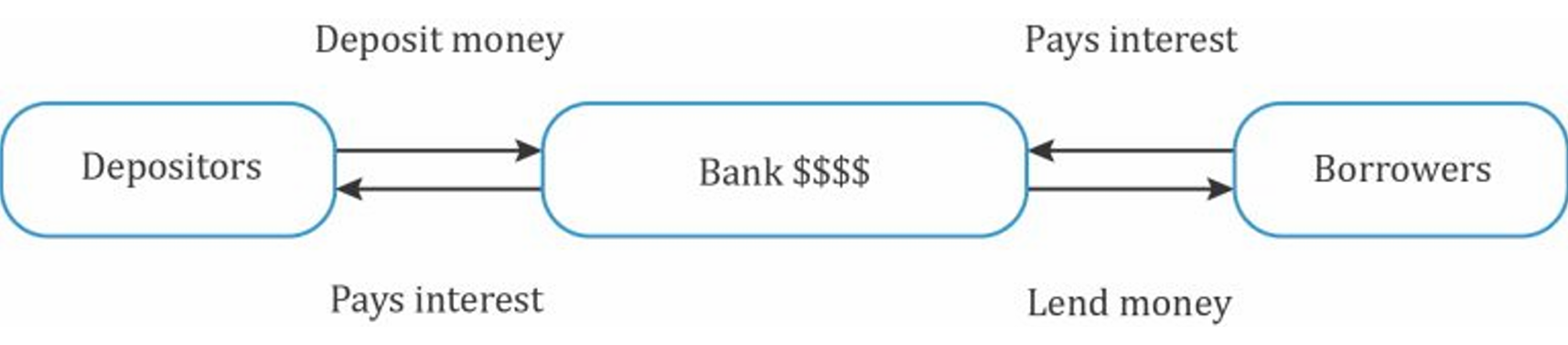
Depositors (or investors) deposit their money in the banks. Banks pay interest to the depositors for using their money and offers services, such as check writing. The banks, in turn, lend this money to borrowers in need of the money. The borrowers pay an interest to the bank. The interest a bank earns from borrowers is usually higher than the interest it pays to the depositors, that is how the bank makes money.
The bank is a financial intermediary here as it connects depositors with borrowers. Banks also raise funds by selling equity or issuing bonds of the bank. ### Insurance Companies --- Insurance companies help people and companies offset risks by issuing insurance contracts. The contracts make a payment to the party that buys the contracts in case an event occurs. Examples of insurance contracts include life, auto, home, fire, medical, theft, and disaster.Assume you own a car and wish to insure the car against any damages. You buy car insurance from an insurance company and pay a premium at periodic intervals (annually). By doing this, you have transferred the risk of car ownership to the insurance company. In case the car is involved in an accident, the insurance company pays for the damages.
Settlement and Custodial Services
A clearinghouse helps clients settle their trades. In futures markets, they guarantee contract performance and, hence, eliminate counterparty risk. By requiring participants to post an initial margin and maintain the margin, the clearinghouse ensures there are no defaults. In other markets they may act as escrow agents, transferring money from the buyer to the seller while transferring securities from the seller to the buyer.
Depositories or custodians hold securities for their clients so that investors are insulated from loss of securities through fraud or natural disasters.
Positions and Short Positions
An investor’s position in a security may either be a long position or a short position.
Long positions
- These are created when a trader owns an asset or has a right or obligation under a contract to purchase an asset.
- Investors who are long benefit from an increase in price of the security.
- A long position can be levered or unlevered.
Short positions
- These are created when traders borrow an asset and sell it, with the obligation to replace the asset in the future.
- Investors who are short benefit from a decrease in price of the security.
Short Positions
Short positions are created when traders sell contracts or stocks they do not own. It is similar to borrowing an asset you do not own.
How to create a short position in a security:

Assume you research a stock – XYZ Corporation – and forecast its price to go down in the short term. To profit from this view, you borrow securities from a long party and sell the borrowed XYZ stock to other traders when it is trading at $50. The stock falls to $40 in line with your forecast. You then close the position by repurchasing and delivering it to the long party, profiting $10 per share in the process.
- The potential gain is bounded, in our example, to a maximum of $50.
That is, the maximum profit you can earn is $50 if the stock falls from $50 to $0.
- Conversely, the potential loss is unbounded.
If the stock’s price increases instead of falling, then the short seller incurs a loss and theoretically, there is no maximum limit to the loss.
This makes a short position very risky. For a long position, the reverse happens. If you own XYZ stock and the stock’s price increases, there is no limit to the maximum profit you can make. However, the loss if the stock falls is limited to $50.
To secure the security loans given to short sellers, security lenders require that proceeds of the short sale be posted as collateral ($50 in the example above). The security lender then invests the proceeds in short term securities and pays interest on collateral to short sellers at rates known as short rebate rates. Security lenders lend their securities because the short rebate rates they pay on the collateral are lower than the interest rates they receive from investing the collateral.
Short Position: Sell the stock (Owe the asset)
- Maximum gain = 100 % of investment
- Maximum loss = unbounded
Long Position: Buy the stock (Own the asset) - Maximum gain = unlimited
- Maximum loss = 100% of investment
Leveraged Positions
In some markets, traders are allowed to buy securities by borrowing some percentage of the purchase price. The leverage ratio is a measure of the amount borrowed relative to the total value of the asset. It shows how many times larger a position is than the equity that supports it.
Your broker allows you to purchase stocks on margin. The initial margin requirement is 40% and the maintenance margin requirement is 25%. You purchase a stock for $50 using $20 of your money and you borrow the rest from the broker. The interest rate on borrowed money is 5%. What is the leverage ratio? At what rate will you receive a margin call?
Solution: You borrow $30, your equity is $20 and the total value of the asset is $50.
- The leverage ratio is
= 2.5. - Margin call price =
= 40.
If the stock price comes down to 40, you still owe the $30 and your equity has come down to $10. This is 25% of $40 (the asset price). If the stock price falls below $40 the equity becomes less than 25%, the maintenance margin.
In this situation, the broker (lender) will ask you to add money to your account such that your equity is at least 25%.
We continue with the earlier example where your initial margin requirement is 40%. You believe stock X will go down in price and decide to short sell 500 shares at the current price of $30. How does the margin requirement impact you?
Solution:
Proceeds from short sale = 500 x 30 = $15,000.
Just like long buyers buy on margin, even short sellers are required to post a margin amount as a security. If the price goes up, then it is a loss for the short seller (you); to mitigate this risk of loss, the broker requires margin traders to maintain a minimum amount of equity in their positions called the maintenance margin requirement.
The margin amount required here is 0.4 * 15,000 = $6,000.
The total return to the equity investment in a levered position considers: Profit or loss on the position– Margin interest paid + Dividends received– Sales commission
To calculate the return percentage on a leveraged position, we need to divide the total profit by the initial investment.
What is the overall return in percentage terms given the following data?
- Purchase price = 30
- Sales price = 32
- Shares purchased = 500
- Leverage ratio = 2
- Call money rate = 5%
- Dividend = $0.50 per share
- Commission = $0.02 per share
Solution:
- Trader’s equity =
= 15 per share i.e. the remaining 15 is borrowed. - Initial investment: (Equity + Commission) x (Number of shares purchased) = 15.02 x 500 = 7,510
- Trader’s remaining equity after the sale can be computed as:
- Proceeds from the sale: 16,000 (32 x 500)
- Payoff loan: -7,500 (15 x 500)
- Margin interest paid: -375 (0.05 x 15 x 500)
- Dividends received: 250 (0.5 x 500)
- Sales commission paid: -10 (0.02 x 500)
- Remaining equity: 8,365
- Total Profit = Equity at End – Initial Investment = 8,365 – 7,510 = 855
- Total Return =
= 11.38%
Orders and Execution Instructions
Brokers, dealers and exchanges arrange the trades between buyers and sellers by issuing orders.
All orders specify the following basic information:
- What instrument to trade (name of the stock, ETF, bond, etc.)
- How much to trade (quantity such as 500 socks of Microsoft Corp.)
- Whether to buy or sell (sell Oracle stock)
Most orders have additional instructions:
- Execution instruction: How to fill the order.
- Validity instruction: When the orders may be filled.
- Clearing instruction: How to arrange the final settlement.
In many markets, dealers are willing to buy/sell from traders. The dealer creates the market. Some important terms:
- Bid and ask price: The prices at which dealers are willing to buy are called bid prices. The prices at which dealers are willing to sell are called ask prices. The ask prices are usually higher than the bid prices.
- Bid and ask size: Traders often trade various quantities of a stock at various prices. The quantities for a bid offer are called bid sizes and the quantities for an ask offer are called ask sizes.
- The highest bid in the market is called the best bid and lowest ask in the market is called the best ask. The difference between the best bid and best offer is the market bid ask spread.
- Bid-ask spreads are an implicit cost of trading. Small bid-ask spread imply lower trading costs and vice-versa.
Execution Instructions
Execution instructions types are:
Market Orders:
- The order is immediately executed at the best price available.
- It executes the order quickly. However there can be substantial slippages in execution price if a stock is thinly traded.
Limit Orders:
- Sets a minimum execution price on sell orders and maximum execution price on buy orders.
- The order ensures that an investor never exceeds his price limit on a transaction.
- However, there is a possibility that the order may not execute at all if the markets are fast moving or there isn’t enough liquidity.
All-or-Nothing Orders:
- These orders will be executed only if the entire quantity can be traded.
- Are beneficial when the trading costs depend on the number of executed trades and not on the size of the order.
Hidden Orders: These are large orders that are known only to the brokers or exchanges executing them until the trades are executed.
=Iceberg Orders:= A small visible portion of a large hidden order is executed first to gauge the market liquidity before the entire order is executed.
From a testability perspective, it is important to note the difference between a market order and a limit order.
| Market Order | Limit Order | |
|---|---|---|
| Execution | Executed at the best available market price. | Sets a minimum execution price on sell orders and maximum execution price on buy orders. |
| Advantages | Quick execution when a trader believes that the prices are volatile. | Avoids slippages as the orders are executed at the pre-determined or better prices. |
| Disadvantages | Quick execution can lead to unfavorable trade prices and has trade price uncertainty. | In a volatile market, the order might be partially filled or not filled at all, making the possibility of missing out on trade. |
| Additional Info | Trader sacrifices price certainty for immediate liquidity. | 3 types of limit orders. |
| Limit Orders |
- Marketable or Aggressively Priced: Limit buy order above the best ask or a limit sell order below the best bid. It will be immediately executed.
- Making a New Market or Inside the Market: Limit price is between the best bid and the best ask.
- Behind the Market: Limit buy order with limit price below the best bid, and limit sell order with limit price above the best ask. If the limit prices are way behind the market, they are termed as far from the market limit orders.
Validity Instructions and Clearing Instructions
Validity instructions types are:
- Day orders: Orders that expire if unfilled for the trading day on which they are submitted.
- Good-till-cancelled orders: Orders that last until the buy or sell order is executed.
- Immediate or cancel (fill or kill) orders: These orders are to be immediately filled, i.e., when they are received by the broker or exchange. If it fails to execute, the order is canceled from the system. \
- Good-on-close (market-on-close): These orders can only be filled at the close of trading. Mutual funds often rely on this order type.
Stop Orders
Also called stop-loss orders, this order comes with a trigger price.
- Stop-sell order executes only if the price is at or below the stop price or trigger price.
- Stop-buy order executes only if the price is at or above the stop price or trigger price.
Clearing Instructions
Clearing instructions tell brokers and exchanges how to arrange final settlement of trades. These instructions convey who is responsible for clearing and settling the trade.
Primary Security Markets
Primary markets are where issuers first sell their securities to investors. For example, when a private company goes public, its shares are issued first to the investors in the primary market before it starts trading in the secondary market.
Public Offerings
Issuers generally contract with an investment bank to help them sell their securities to the public. The investment bank builds the list of subscribers who will buy the security. This process is known as book building. Investment banks attract investors by providing investment information and opinion about the issuing company.
In an accelerated book build, issuers may issue securities with the help of an investment bank in only one or two days.
The two major types of offerings provided by investment banks are the underwritten offering and the best efforts offering.
- Underwritten offering: The investment bank guarantees the amount of shares and the price at which they will be sold (think of it as though the issuer has sold the entire issue to the investment bank, who then sells it to other investors through the book building process). This price is called the offering price.
Assume the investment bank promises to sell 1,000,000 shares at $20 and only 800,000 are sold. If the entire issue is not sold, the investment bank buys the remaining securities at the offering price, in this case it buys the remaining 200,000 shares. The issuer pays an underwriting fee of about 7% to the bank for these services.
- Best efforts offering: Unlike underwritten offering, in this case the investment bank only serves as a broker to bring investors to the issuer. Any securities not sold in an undersubscribed issue will remain as is.
An IPO (Initial Public Offering) is where issuers sell securities to the public for the first time.
- IPO could be oversubscribed or undersubscribed.
- If the offering price is low, more investors will be interested in subscribing than the number of shares issued (oversubscribed).
- If the price is high, less number of investors will be interested, leading to the issue being undersubscribed.
- Investment banks have a conflict of interest in their dual role as agents and underwriters in choosing the right offering price. As an underwriter, it is in the interests of the investment bank to have the offering price as low as possible. But as agents for issuers, the offering price should be right to raise the required amount of money for the issuer.
A seasoned or secondary offering is where an issuer sells additional units of a previously issued security.
A company might have raised $10 million through an IPO and four years later wants to raise another $15 million through a secondary offering.
The secondary offering is a transaction between the issuer and investors.
Private Placements and Other Primary Market Transactions
A private placement is where corporations sell securities directly to a small group of qualified (sophisticated) investors as opposed to the public. Private placement requires relatively low disclosure requirements because qualified investors are aware of the risks involved. It is less costly than a public offering.
In a shelf registration, corporations sell seasoned securities directly to the public on a piecemeal basis over time instead of selling it in a single transaction. They are sold in secondary markets.
Consider a publicly traded company that announces the sale of 700,000 shares to a small group of qualified investors at €0.75 per share. This is an example of a private placement and not shelf registration because the company is not selling on a piecemeal basis.
In a rights offering, companies distribute the right to buy new stock at a fixed price to existing shareholders in proportion to their holdings.
A publicly traded Italian company is raising new capital. Its existing shareholders may purchase three shares for €3.07 per share for every 10 shares they hold.
Importance of Secondary Markets to Primary Markets
Primary markets are where entities raise money. Secondary markets are markets where investors trade (buy/sell) in securities. The cost of raising capital in primary markets is lower for corporations and governments whose securities trade in liquid secondary markets. In a liquid market, the transaction costs are low to buy/sell a security. Since investors value liquidity, they are willing to pay more for liquid securities. These high prices result in lower costs of capital for issuers.
Secondary Security Market and Contract Market Structures
Trading in securities takes place in a variety of structures. We will consider three aspects of market structure:
- Trading Sessions
- Execution Mechanisms
- Market Information Systems
Trading Sessions
The two categories of securities market based on when they are traded are as follows:
- Call markets:
- Trade takes place only at specific times of the day where all the traders are present and all bid-ask quotes are used to arrive at one negotiated price.
- Markets are highly liquid when the market is in session and illiquid when the market isn’t in session.
- Usually used for smaller markets or to determine the opening and closing prices at stock exchanges.
- Continuous markets:
- Trades can occur at any time the market is open where the prices are either quote-driven or auction-driven.
At the start of the trading day, the limit order book for stock X looks as follows:
| Buyer | Bid Size | Limit Price | Offer Size | Seller |
| ----- | -------- | ----------- | ---------- | ------ |
| John | 150 | 30 | | |
| Joe | 80 | 31 | | |
| Jill | 100 | 32 | | |
| | | 33 | 40 | Sam |
| | | 34 | 60 | Simon |
| | | 35 | 120 | Sue |
Tom submits an order to buy 150 shares, limit $34. What is the impact on the limit order book?
Solution
Tom has placed a marketable limit order. He will buy 40 shares from Sam and 60 shares from Simon as these satisfy the limit price criteria of at or below $34. He will not buy from Sue as hers is a limit order of $34.
Only 100 shares are filled; 50 remain unfilled. Average price = 0.4 x 33 + 0.6 x 34 = 33.6
In the limit order book, Tom is a buyer with bid size of 50 at a price of $34. Sam and Simon’s orders are removed from the limit order book as they are filled. It looks like this:
| Buyer | Bid Size | Limit Price | Offer Size | Seller |
| ----- | -------- | ----------- | ---------- | ------ |
| John | 150 | 30 | | |
| Joe | 80 | 31 | | |
| Jill | 100 | 32 | | |
| Tom | 50 | 34 | | |
| | | 33 | 40 | Sam |
| | | 34 | 60 | Simon |
| | | 35 | 120 | Sue |
Execution Mechanisms
The three categories of the securities market based on how they are traded are as follows:
- Quote-Driven Markets:
- Trade takes place at the price quoted by dealers who maintain an inventory of the security.
- Dealers provide liquidity in these markets and gain from the difference in bid-ask spread (high in opaque market).
- They are also called over-the-counter markets, price-driven, or dealer markets.
- Order-Driven Markets:
- Trading rules match buyers to sellers, thus making them supply liquidity to each other.
- Trading rules uses two sets of rules:
- Order matching rules: This establishes the order precedence based on price, their arrival time, and other factors.
- Trade pricing rules: This determines the price of the transaction.
- Brokered Markets:
- Brokers arrange trades between counterparties.
- Used for instruments that are unique or illiquid, like real estate or art pieces.
Market Information Systems
The two categories of the securities market based on when the information is disclosed are as follows:
- Pre-trade transparent: Here trade information on quotes and orders is publicly available prior to the trades.
- Post-trade transparent: Here trade information on quotes and orders is publicly available after the trade.
Well-Functioning Financial Systems
Why do we need a well-functioning financial system?
- Investors can save (move money from the present to the future) and obtain a fair rate of return.
- Borrowers can borrow money easily (move money from the future to the present).
- Hedgers can offset their risks.
- Traders can trade currencies for commodities.
4 characteristics of a well-functioning financial system include:
- Well-developed markets trade instruments that help people solve their financial problems.
- Liquid markets with low cost of trading (operationally efficient markets) where commissions, bid-ask spreads and order price impacts are low.
- Timely and accurate financial disclosures that allow market participants to forecast the value of securities (support informationally efficient markets).
- Prices that reflect fundamental values (informationally efficient markets).
Market Regulation
The role of a market regulator is to ensure fair trading practices.
The objectives of market regulation are to:
- Prevent fraud.
- Control agency problems by setting minimum standards of competence for agents.
- Promote fairness.
- Set mutually beneficial standards such as IFRS or U.S. GAAP.
- Prevent undercapitalized firms from exploiting their investors by making excessively risky investments.
- Ensure that long-term liabilities are funded.