Financial Reporting Quality
Go to Financial Statement Analysis
Topics
Table of Contents
Introduction & Conceptual Overview
There are two main interrelated concepts that will be discussed in detail in this reading: financial reporting quality and earnings quality.
Financial reporting quality: High-quality financial reporting provides information that is useful to analysts in assessing a company’s performance and prospects. They contain information that is relevant, complete, neutral, and free from error.
High-quality reporting helps in making the right decision as it depicts the true economic reality of a company for the reporting period. Low-quality financial reporting contains inaccurate, misleading, or incomplete information.
Earnings quality: High-quality earnings result from activities that a company will likely be able to sustain in the future and provide a sufficient return on the company’s investment. If the return on investment is greater than the cost of funds, then it indicates high earnings quality.
Sustainability is the key here.
A company uses accrual-based earnings in a quarter. It has high accounts receivable and as a result reports high earnings, which is not sustainable in the following quarters → Earnings quality is low.
Quality Spectrum of Financial Reports
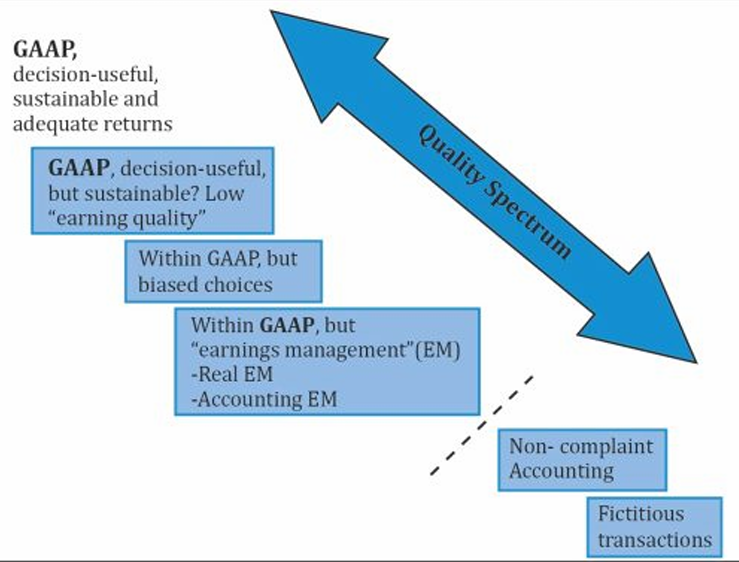
Combining the two aspects – financial reporting quality and earnings quality, we get a spectrum spanning from highest to lowest.
Let us now look at the characteristics of reporting/earnings quality as we move down along the spectrum as shown in the exhibit below.
GAAP Compliant
- Decision useful. The earnings are also sustainable and adequate.
- Decision useful. However, earnings quality is low, i.e., the earnings are not sustainable or adequate.
- Reporting choices and estimates used while preparing the reports are biased.
- Amount of earnings is actively managed. The intent is to increase/decrease/smooth reported earnings.
Not GAAP Compliant - Reports are based on the company’s actual economic activities.
- Reports contain numbers that are fictitious.
Non-GAAP reporting of financial metrics which is not in compliance with generally accepted accounting principles such as US GAAP and IFRS includes both financial metrics and operating metrics. Non-GAAP earnings are sometimes referred to as underlying earnings, adjusted earnings, recurring earnings, or core earnings.
Differentiate between Conservative and Aggressive Accounting
The choice of accounting methods used can distort the economic reality. Unbiased financial reporting is the ideal, but investors may prefer conservative accounting choices as a positive surprise is acceptable. Whereas the management may prefer aggressive accounting choices.
- Aggressive accounting: It refers to biased accounting choices that aim to improve the reported earnings or financial position in the period under review.
- Conservative accounting: It refers to biased accounting choices that aim to decrease the reported earnings or financial position in the reporting period.
Some managers use aggressive accounting when earnings are below targets and conservative accounting when earnings are above targets, to artificially smooth earnings.
When a company makes conservative choices, it implies that:
- revenue is recognized only when earned and when collections are reasonably certain.
- expenses/losses are recognized when probable.
- earnings will be understated in the current period.
Context for Assessing Financial Reporting Quality
Motivations
Managers may be motivated to issue financial reports that are not high quality in order to:
- mask poor performance.
- boost the stock price.
- increase personal compensation.
- avoid violation of debt covenants.
Conditions Conducive to Issuing Low-Quality Financial Reports
The three conditions conducive for issuing low-quality financial reports are presented below:
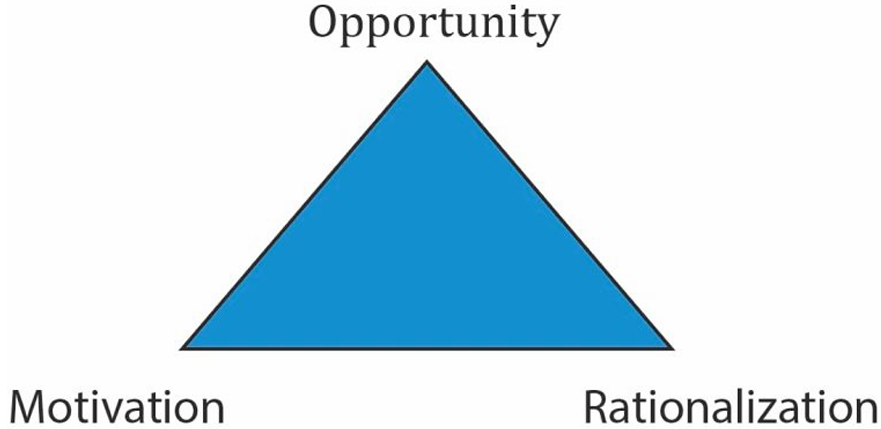
- Opportunity: It can be the result of weak internal controls, ineffective board of directors, and accounting standards that allow a range of choices.
- Motivation: It can result from pressure to meet some criteria for some personal reasons.
- Rationalization: It can result from justifying a wrong choice as seen in Enron’s case. Enron’s CFO sought board approvals, legal and accounting opinions for misstated financial statements.
Mechanisms that Discipline Financial Reporting Quality
Market Regulatory Authorities
Regulators in every country can play a key role in enforcing financial reporting quality. Examples of regulatory authorities include:
- SEC (Securities Exchange Commission)
- SEBI (Securities and Exchange Board of India)
- Securities and Futures Commission in Hong Kong.
These regulatory authorities are members of an international organization called the International Organization of Securities Commissions (IOSCO), comprising 120 regulatory authorities and 80 securities market participants like the stock exchanges.
The actual regulation, however, is enforced through each individual regulatory authority in a country. The features of any regulatory regime such as the SEC that affect financial reporting quality include the following:
- Registration requirements: Publicly traded companies must register securities before offering securities for sale to the public. A registration document (often known as a prospectus in an Initial Public Offering) contains current financial statements, future prospects of the company, and securities being offered.
- Disclosure requirements: Publicly traded companies are required to make public periodic reports such as financial statements.
- Auditing requirements: The financial statements must be audited by an independent auditor that states the statements conform to the accounting standards.
- Management commentaries: Financial reports must include statements by the management. Some regulators require a management report containing
- (1) a fair review of the issuer’s business
- (2) a description of the principal risks and uncertainties facing the issuer
- Responsibility statements: Individuals responsible for company’s filings must issue a statement explicitly acknowledging responsibility and correctness of the information in the reports. Falsely certifying may be considered criminal offence and attract a jail sentence.
- Regulatory review of filings: Regulators conduct reviews periodically to ensure that the rules have been followed.
- Enforcement mechanisms: Regulators have the authority to enforce these rules, without which the rules are of no significance. These powers include fines, barring market participants, or bringing criminal charges.
Auditors
Financial statements of public companies must be audited by an independent auditor.
Auditors issue opinions on the financial statements of the company and on the effectiveness of the companies’ internal controls.
An unqualified opinion on the financial statements indicates that the financial statements present fairly the company’s performance in accordance with relevant standards. Key audit matters discuss matters of most significance in the audit of the financial statements of the current period.
However, there are some drawbacks of audited opinion:
- It is based on information provided by the company.
- Only a sample is audited, which may not reveal misstatements.
- The intent of the auditor is not to detect fraud, but to ensure that the information is presented fairly.
- The company being audited pays the audit fees. The auditor has an incentive to be lenient to the company being audited in case of a conflict of interest; particularly if the auditor’s firm provides additional services to the company.
Private Contracting
We have seen earlier that managers are motivated to manipulate earnings in order to avoid violating debt covenants or triggers that may prompt investors to recover all or part of their investment.
A company takes a loan from a bank; there is every incentive for the company to dress up its financial reports to keep its cost of capital low. So it is in the best interest of investors, such as the bank here, to monitor the quality of financial reports and detect any misreporting.
Detection of Financial Reporting Quality Issues: Introduction & Presentation Choices
Analysts must be able to understand the choices that companies make in financial reporting while evaluating the overall quality of reports – both financial reporting quality and earnings quality. There is no right or wrong choice. The intent of the management is what makes the difference.
Choices exist both in how information is presented (financial reporting quality) and in how financial results are calculated (earnings quality).
- Choices in presentation are often transparent.
- Choices in the calculation of financial results are more difficult to detect.
Ways to increase performance and financial position in the reporting period include the following:
- Recognize revenue prematurely. Ex: a software services company recognizes revenue before the services are delivered to a client. Revenue and earnings will be overstated in the current period.
- Use non-recurring transactions to increase profits. Ex: selling accounts receivable, which increases earnings in an unsustainable manner.
- Defer expense to later periods. Ex: warranty expense for a sale that happened in this period should be recognized now and not put off for later. Deferring understates expense.
- Measure and report assets at higher values
- Measure and report liabilities at lower values. Equity will be overstated if assets are higher and liabilities are lower.
Ways to increase performance and financial position in a later period include the following:
- Defer current income to a later period (save income for a rainy day)
- Recognize future expenses in a current period; setting the table for improving future performance. Ex: cookie jar reserve accounting. Higher expenses are reported in the current period. This allows earnings in the later period to be overstated because lower expenses are reported later.
Presentation Choices
- Companies may use
strange new metrics. Metrics are set by a company or an industry, and not by a standard-setting body. For example, website companies started using metrics such aseyeballsorstickinessto measure user engagement and operating performance; traditional valuation methods such as P/E could not justify their stock prices. - Companies may present
pro forma earnings. These are earnings that are not prepared in accordance with any standard such as US GAAP or IFRS. Analysts must be careful about the assumptions made in the financial reports as they may be manipulated to make the earnings look better. Ex: companies would exclude huge restructuring charges (to the tune of $3-$7 billion) in performance presentation to make earnings look good to investors. - EBITDA is earnings before interest, taxes, depreciation, and amortization. It is often used as a proxy for operating cash flow. EBITDA is used to compare companies as the expense incurred for depreciation, amortization, and restructuring may vary with the choice of accounting method. Companies may construct their own version of EBITDA by excluding the following from net income:
- Rental payments for operating leases.
- Equity-based compensation, usually justified on the grounds that it is a non-cash expense.
- Acquisition-related charges.
- Impairment charges for goodwill or other intangible assets.
- Impairment charges for long-lived assets.
- Litigation costs.
- Loss/gain on debt extinguishments.
- If companies are compared using EBITDA measure, then it must be ensured that the companies calculate EBITDA in a similar manner and the same assumptions are made.
- IFRS requires a definition and explanation of any non-IFRS measures included in financial reports.
- Similarly, if a company uses a non-GAAP financial measure, then it must also include the closest GAAP measure with prominence. It must also explain why the non-GAAP measure is a better choice to represent the company’s financial condition than the GAAP measure.
Accounting Choices and Estimates and Their Effects
In this section, we look at the accounting methods (choices and estimates) made by the management for a desired outcome such as earnings growth or meeting the numbers.
How Choices Affect the Cash Flow Statement
A cash flow statement has three sections:
- Cash flow from operations (CFO): This is of most interest to investors. The CFO is insulated from manipulation more than the income statement. For instance, if a large part of the earnings is from accruals, then it should raise a red flag.
- Cash flow from investing (CFI)
- Cash flow from financing (CFF)
How the Cash Flow Statement is Manipulated?
- Misclassification of cash flows: Analyze the composition of CFO closely.
If a certain cash outflow should be classified as part of CFO but is instead shown as CFI, or if a cash inflow must be part of CFI but shown as CFO, then it indicates manipulation.
- Payables management: Decrease in accounts payables is a use of cash.
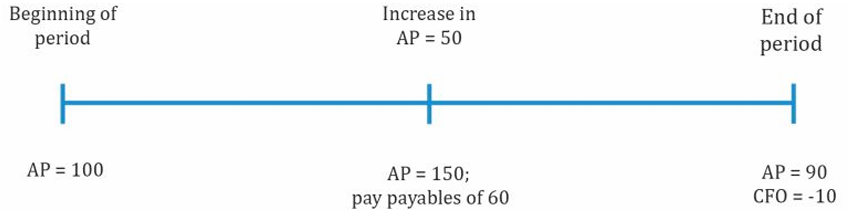
If company wanted to manipulate the CFO. It could delay the payable by stretching the credit period, which will increase the CFO by +50.
- Interest capitalization: This is due to the differences between interest payments and interest costs.
Assume a company takes a loan to construct a factory. It pays an interest of 100,000 in a given period of which 70,000 is the interest expense (on the income statement) and 30,000 is capitalized interest on the loan taken. The amount that will show up as interest in CFO will be 70,000 and 30,000 in CFI.
- Flexibility in the classification of interest/dividends paid and received: Interest paid and interest/dividends received may be classified as operating cash flow.
- Interest paid can be classified as a financing cash flow and interest/dividends received can be classified as investing cash flows.
- Dividend paid may be classified as a financing cash flow or cash flow from operating activities.
Analysts should:
- Examine the composition of the operations segment.
- Compare company’s cash generation with other companies in the industry; study relationship between net income and CFO.
How Accounting Choices and Estimates Affect Earnings and Balance Sheets
This section identifies areas where choices affect financial reporting and the questions analysts must ask to assess the quality of reporting.
Revenue Recognition
- How is the revenue recognized, upon shipment or upon delivery of goods?
- Is the company engaged in
channel stuffing– the practice of overloading a distribution channel with more product than it is normally capable of selling?
A washing machine manufacturer pressurizes a retailer to sell more machines through special discounts. The threat is that the retailer may return unsold units.
- Does the company engage in
bill-and-hold transactions- bills the customer, recognizes revenue but does not ship the product ? - Does the company use rebates as part of its marketing approach? If so, how significantly do the estimates of rebate fulfillment affect net revenues? And have any unusual breaks with history occurred?
- Does the company separate its revenue arrangements into multiple deliverables of goods or services?
Long-Lived Assets: Depreciation Policies
- Companies have a choice to use one of the three depreciation methods:
- Straight-line
- Accelerated double-declining-balance method
- Units-of-production method
- Compared to straight line depreciation, using an accelerated depreciation increases the depreciation expense and reduces net income in the early years of an asset’s life.
- Depreciation expense: Depends on the method used and the salvage value of the assets being depreciated.
A high salvage value reduces the depreciation expense and increases net income.
- Analysts must consider if the estimated life spans of the associated assets make sense, or are they unusually low compared with others in the same industry? And if there have been changes in depreciable lives that have a positive effect on current earnings.
Using a longer estimated useful life reduces the depreciation expense and increases the net income in the early years of an asset’s life.
Inventory Costing Method
Companies cannot arbitrarily switch between inventory costing methods once the policy decision is made. For example, a cost flow assumption between FIFO vs. weighted average cost can lead to different values for income statement and balance sheet items, and eventually affect profitability.
- FIFO understates cost and overstates ending inventor during periods of rising prices.
- The balance sheet is a mix of old and new inventory costs. Understates inventory if costs are rising.
Analysts must examine the following:
- Does the company use a costing method that produces fair reporting results in view of its environment? How do its inventory methods compare with others in its industry? Are there differences that will make comparisons uneven if there are unusual changes in inflation?
- Does the company use reserves for obsolescence in its inventory valuation? If so, are they subject to unusual fluctuations that might indicate adjusting them to arrive at a specified earnings result?
- If a company reports under US GAAP and uses last-in, first-out (LIFO) inventory accounting, does LIFO liquidation (assumed sale of old, lower-cost layers of inventory) occur through inventory reduction programs?
This inventory reduction may generate earnings without supporting cash flow, and management may intentionally reduce the layers to produce specific earnings benefits.
Capitalization Policies of Intangible Assets
Another example of how choices affect both the balance sheet and income statement is in the use of capitalization.
-
If the payment benefits only the current period, then it must be classified as an expense.
-
If it will be used in future periods, then it must be capitalized.
-
Does the company capitalize expenditures related to intangibles, such as software?
-
Does its balance sheet show any R&D capitalized as a result of acquisitions?
-
If the company is an IFRS filer, has it capitalized any internally generated development costs?
Goodwill
When a company acquires another company, and the acquiring company pays more than its fair value, then goodwill is created. The fair value of the assets created is based on the management’s estimate. The depreciable value of assets is kept low to lower the depreciation expense, and the amount that cannot be allocated to specific assets is classified as goodwill.
The initial value of the goodwill is objective. Over time, the value of goodwill is subjective. Companies must test goodwill for impairment annually on a qualitative basis. The value of the assets reported depends on the management’s intent; if the fair value of assets cannot be recovered, the company must write-down goodwill. To avoid writing down goodwill, the company may project a better future performance.
Allowance for Doubtful Accounts/Loan Loss Reserves
- Are additions to such allowances lower or higher than in the past?
If the allowance for doubtful accounts must be 3% based on historical transactions, a company can report 2% instead in order to boost earnings. Analysts must verify if the allowances are justified.
- Does the collection experience justify any difference from historical provisioning?
- Is there a possibility that any lowering of the allowance may be the result of industry difficulties along with the difficulty of meeting earnings expectations?
Related-Party Transactions
- Is the company engaged in transactions that disproportionately benefit members of management? Does one company have control over another’s destiny through supply contracts or other dealings?
- Do extensive dealings take place with non-public companies that are under management control?
If so, non-public companies could absorb losses (through supply arrangements that are unfavorable to the private company) and make the public company’s performance look good. This scenario may provide opportunities for an owner to cash out.
Tax Asset Valuation Accounts
Tax assets, if present, must be stated at the value at which management expects to realize them, and an allowance must be set up to restate tax assets to the level expected to eventually be converted into cash.
Determining the allowance involves an estimate of future operations and tax payments.
- Does the amount of the valuation allowance seem reasonable, overly optimistic, or overly pessimistic?
If a company records a DTA which expires in three years, analysts must analyze if a company can become profitable within this period.
- Are there contradictions between the management commentary and the allowance level, or the tax note and the allowance level?
There cannot be an optimistic management commentary and a fully reserved tax asset, or vice versa. One of them has to be wrong.
- Look for changes in the tax asset valuation account. It may be 100% reserved at first, and then “optimism” increases whenever an earnings boost is needed.
Lowering the reserve decreases tax expense and increases net income. If the valuation allowance is lower, then DTA and net income increases.
Warning Signs
Warning signs of information manipulation in financial reports can be seen as manipulation in:
- Biased revenue recognition.
- Biased expense recognition.
The bias may be with respect to:
- Timing of recognition: Deferring expenses by capitalizing.
- Location of recognition: Showing a loss in other comprehensive income instead of the income statement.
Analysts must look at the following for warning signs:
- Pay attention to revenue. Examine the accounting policies note for a company’s revenue recognition policies. Studies have shown that most manipulations relate to revenue recognition; the largest number on the income statement.
- Does the company recognize revenue prematurely; revenue recognition upon shipment of goods or bill-and-hold sales?
- Does the company engage in barter transactions?
- Are rebates offered? If yes, by how much, as these can affect revenue recognition?
- How will revenue be recognized for multiple-deliverable arrangements of goods and services?
- Look at revenue relationships.
- Compare a company’s revenue growth with that of its competitors, industry, or the economy.
- If the company outperforms, then there must be a justifiable performance like superior management or product differentiation.
- If not, it should be a cause of concern.
- Compare accounts receivable with revenue to see if it is increasing as a percentage of revenue over the years.
- It may indicate relaxed credit terms or channel stuffing.
- Analyze asset turnover to see if the assets are efficiently used.
- If an asset turnover is declining, then it indicates assets may be written down in the future.
- Compare a company’s revenue growth with that of its competitors, industry, or the economy.
- Pay attention to signals from inventories.
- Look at the growth in inventories relative to competitors and industry.
- Look at the inventory turnover ratio.
- If the ratio is declining, it may mean obsolescent inventory.
- US GAAP allows use of LIFO for inventory accounting. If prices increase, analysts must check to see that old inventory has not been passed through earnings (LIFO liquidation) to boost net profits.
- Pay attention to capitalization policies and deferred costs.
- Compare a company’s accounting policy for capitalization of long-term assets, interest costs, and handling of deferred costs with that of its competitors and the industry.
- If only this company is capitalizing costs while others are expensing, then it is a warning sign.
- Compare a company’s accounting policy for capitalization of long-term assets, interest costs, and handling of deferred costs with that of its competitors and the industry.
- Pay attention to the relationship of cash flow and net income.
- Construct a time series of cash flow from operations divided by net income.
- If the ratio is consistently less than 1.0, then it indicates a problem with accrual accounts, i.e., net income is shown higher than it should be.
- Construct a time series of cash flow from operations divided by net income.
Other Potential Warning Signs
Other areas that require further analysis include:
- Depreciation methods and useful lives.
- Fourth-quarter surprises: For non-seasonal businesses, over- or under-performance in the fourth quarter of a year routinely is a red flag.
- Presence of related-party transactions: What is the intent behind related-party transactions, often by founding members of a company?
- Non-operating income or one-time sales included in revenue: To mask declining revenues, companies may include one-time gain as part of revenue. Ex: In 1997, Trump Hotels included a one-time gain from a lease termination as part of revenue.
- Classification of expenses as non-recurring.
- Gross/operating margins out of line with competitors or industry.
- Younger companies with an unblemished record of meeting growth projections.
- Management has adopted a minimalist approach to disclosure: Is the management withholding information from competitors?
- Management fixation on earnings reports.