Business Models
Go to Corporate Issuers
Topics
Table of Contents
Introduction
This reading covers:
- What is a business model
- The types of business models
A well-defined business model helps analysts in understanding a company’s operations, strategy, target customers, key partners, prospects, risks, and financial profile.
Many companies have conventional business models that are easily understood, such as manufacturer, wholesaler, retailer, restaurant chain etc.
However, the advent of digital technology has changed the way most businesses operate, and enabled disruption of existing business models. Many companies now have business models that are complex, specialized, or new.
Defining the Business Model
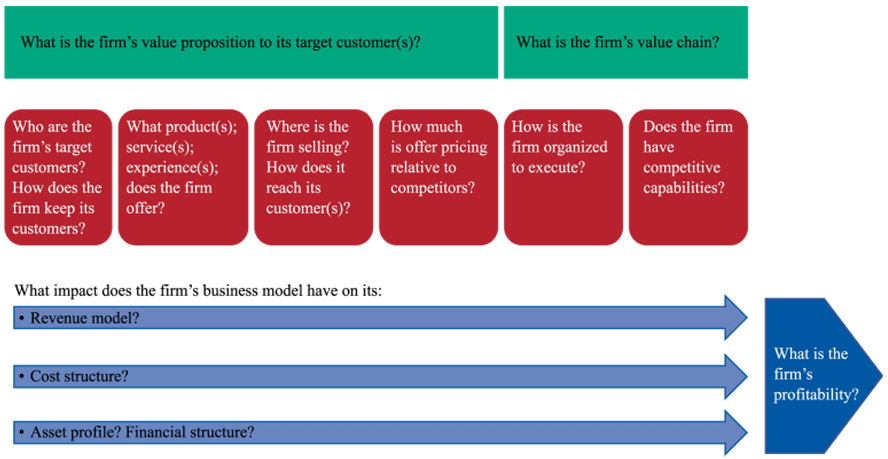
A business model describes how a business is organized to deliver value to its customers:
- who its customers are
- how the business serves them
- key assets and suppliers
- supporting business logic
A business model explains what the company does, how it operates, and how it generates revenue and profits, as well as how it differs from competitors. It provides enough detail to understand the basic relationships between these key elements, however, it does not provide a full description.
For a full description (such as detailed financial forecasts) we would have to refer to a business plan.
A business model should have a value proposition and a value chain.
- The firm’s
value propositionrefers to the product or service attributes valued by a firm’s target customer that lead those customers to prefer a firm’s offering over those of its competitors, given relative pricing. - The firm’s
value chainrefers to how the firm is structured to deliver that value. It refers to the systems and processes within a firm that create value for its customers.
Business Model Features
The key features of a public company’s business model are often provided in annual reports or other disclosure documents. As an example, the curriculum presents the ‘business description’ from Tesla’s annual report.
We design, develop, manufacture, sell and lease high-performance fully electric vehicles and energy generation and storage systems, and offer services related to our products. We are the world’s first vertically integrated sustainable energy company, offering end-to-end clean energy products, including generation, storage and consumption. We generally sell our products directly to customers, including through our website and retail locations.
We also continue to grow our customer-facing infrastructure through a global network of vehicle service centers, Mobile Service technicians, body shops, Supercharger stations and Destination Chargers to accelerate the widespread adoption of our products. We emphasize performance, attractive styling and the safety of our users and workforce in the design and manufacture of our products, and are continuing to develop full self-driving technology for improved safety.
We also strive to lower the cost of ownership for our customers through continuous efforts to reduce manufacturing costs and by offering financial services tailored to our vehicles. Our sustainable energy products, engineering expertise, intense focus to accelerate the world’s transition to sustainable energy and achieve the benefits of autonomous driving, and business model differentiate us from other companies.
Customers, Market: Who
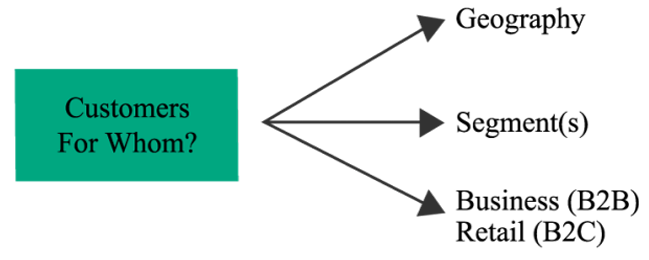
A business model should identify the firm’s target customers:
- What geographies will be served?
- What market segments will be served? (e.g., high income suburban families)
- What customer segments will be served? Is this a business (B2B) or consumer (B2C) market?
Business description does not specify which customer segments are being targeted.
This is because it’s target market is shifting over time toward the mass market, as costs and prices decline.
Firm Offering: What
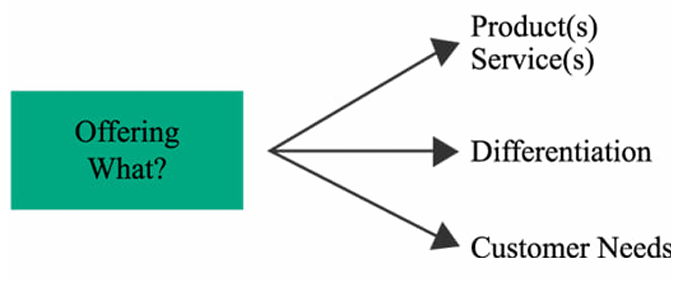
A business model should define:
- What products and services are being offered?
- What differentiates these offerings from competitors?
- How are the needs of its target customers being met?
Instead of using a broad description such as
electric carto describe its product offering; they has used a more precise description that is useful to analysts– “high-performance fully electric vehicles and energy generation and storage systems”.
Channels: Where
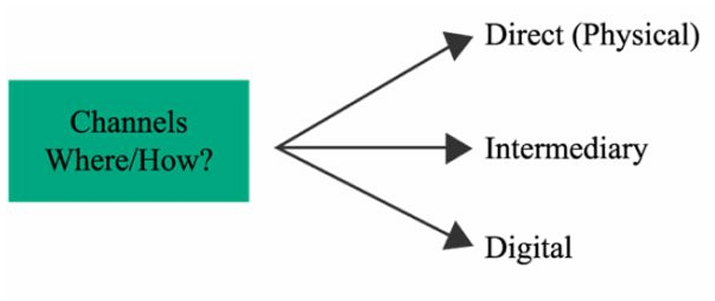
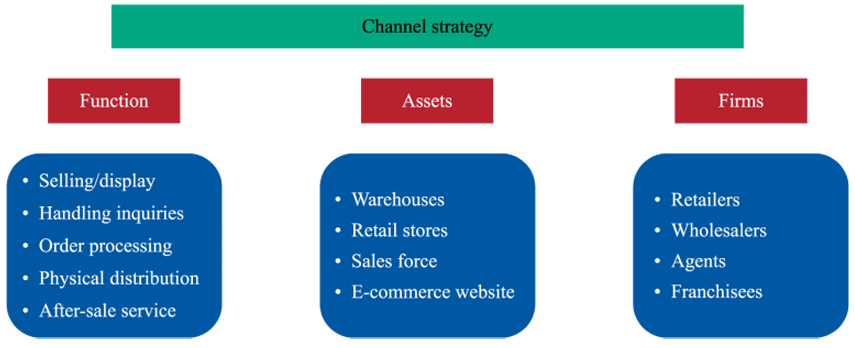
A firm’s channel strategy refers to “where” the firm is selling its offering and how it is reaching its customers.
Channel strategy typically involves two main functions:
- Selling the firm’s products and services
- Delivering them to customers
When evaluating a firm’s channel strategy, it is important to distinguish the functions performed, from the assets that might be involved, and different firms that might be involved in performing those functions or owning those facilities.
Many product businesses, employ a traditional channel strategy, that reflects the flow of finished goods (e.g., from manufacturer to wholesaler, retailer, and end customer). However, some manufacturers may employ a direct sales strategy, selling directly to the end customer. This strategy bypasses (or disintermediates) the distributor and retailer.
Typically, direct sales involved the use of the company’s own sales force and was very expensive. However, with e-commerce, direct sales have now become a cost-effective strategy.
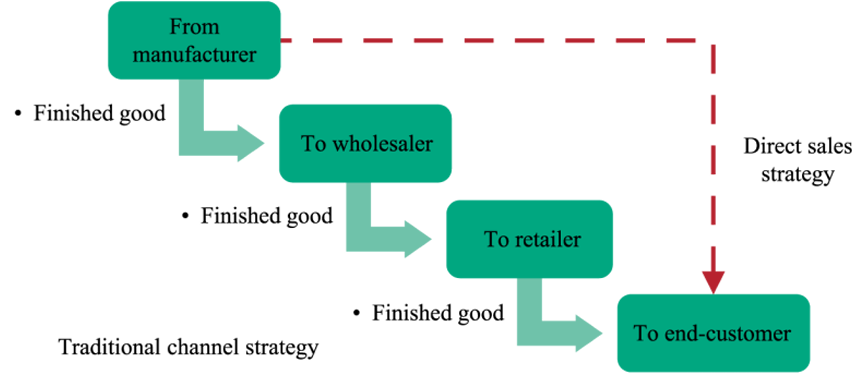
When an intermediary is involved, that intermediary may work on an agency basis, earning commissions, rather than taking ownership of the goods (e.g., auctioneers such as Sotheby’s that deal in fine art).
The drop shipping model in e-commerce allows an online marketer to have goods delivered directly from the manufacturer to the end customer without taking the goods into inventory.
Companies often use several channels in tandem. With an omnichannel strategy, both digital and physical channels are used to complete a sale. For example, a customer might order an item online and pick it up in a store (click and collect).
It is important to understand how a firm’s channel strategy differs from those of its competitors.
Tesla mentions its direct sales strategy, which differs from the franchised dealer model used by most automakers.
Pricing: How Much
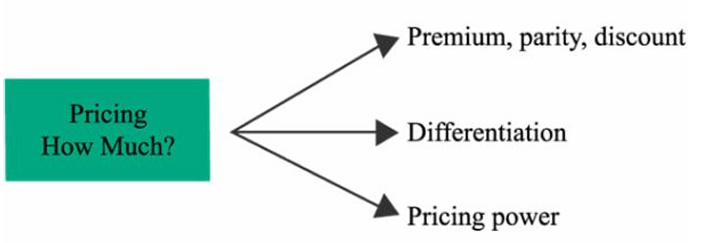
A business model should answer the following questions related to pricing:
- Does the firm price at a premium, parity, or discount relative to competitors?
- How is the firm’s pricing justified in its business model?
Based on pricing power companies can be classified into:
- Price takers – Companies with little differentiation are “commodity” producers who must accept market prices dictated to them. Such companies focus on other sources of value such as employing a discounting strategy to build scale and a cost advantage (e.g., Walmart).
- Price setters – Companies with high differentiation can command premium pricing and face significantly less pricing risk from competitors.
Most firms try to differentiate their offerings in some way to achieve some degree of pricing power.
Tesla focuses on the total cost of ownership which factors in government subsidies and lower operating costs for electric vehicles as an offset to higher purchase prices.
Pricing and Revenue Models
Pricing approaches are typically value based or cost based.
- Value-based pricing attempts to set pricing based on the value received by the customer. For example, Tesla can command a premium price because they have low operating costs, which is a source of value for their customers.
- Cost-based pricing attempts to set pricing based on costs incurred. For example, an environmental law firm may charge clients by the hour because it is difficult to predict how many hours (cost) will be required and how much value the client will receive.
Price Discrimination
Price discrimination refers to situations where firms charge different prices to different customers. The objective of price discrimination is to maximize revenues in a situation where different customers have different willingness to pay.
Common pricing strategies in this category include:
- Tiered pricing charges different prices to different buyers, most commonly based on purchase volume.
- Dynamic pricing charges different prices at different times. For example, off-peak pricing offered by hotel rooms and airlines, and movie tickets; and surge pricing offered by ride sharing companies.
- Auction/reverse auction models establish prices through bidding.
Pricing for Multiple Products
Firms selling multiple products frequently use the following pricing models:
- Bundling refers to combining multiple products or services so that customers are incentivized, or required, to buy them together. For example, cable TV and internet services, prepackaged set of kitchen utensils.
- Razors-and-blades pricing combines a low price on a piece of equipment and high-margin pricing on repeat-purchase consumables. For example, razors and blades, printers and refill cartridges.
- Optional product pricing applies when a customer buys additional services or product features, either at the time of purchase or afterward. For example, deluxe interior for a car, a side order with a restaurant meal.
Pricing for Rapid Growth
- Penetration pricing: A firm willingly sacrifices margins in order to build scale and market share. For example, Netflix subscriptions, Amazon e-readers.
- Freemium pricing: Allows customers a certain level of usage or functionality at no charge. For example, mobile games, software applications.
- Hidden revenue business models: Provide free services to users while generating revenue elsewhere. For example, media sector which provides free content and paid advertising.
Alternatives to Ownership
Some business models create value by offering an alternative to purchasing an asset or product, such as:
- Recurring revenue/subscription pricing: Enables customers to rent a product or service for as long as they need it. For example, TV channels, telecommunication services.
- Fractionalization: Creates value by selling an asset in smaller units or through the use of an asset at different times. For example, web hosting which allows sharing of server capacity, Office sub-leasing/co-working.
- Leasing: Involves shifting the ownership of an asset from the firm using it to an entity that has lower costs for capital and maintenance. For example, real estate, aircrafts.
- Licensing: Gives a firm access to intangible assets (e.g., brand name, song, patented formula) in return for royalty payments.
- Franchising: It is a more comprehensive form of licensing, in which the franchisor typically gives the franchisee the right to sell or distribute its product or service in a specified territory and to receive marketing and other support
Value Proposition (Who + What + Where + How Much)
A firm’s value proposition refers to the product or service attributes valued by a firm’s target customer that lead those customers to prefer a firm’s offering over those of its competitors, given relative pricing.
Value propositions can arise from:
- The product itself – e.g., performance, features style etc.
- Service and support – e.g., access to repairs, spare parts etc.
- The sale process – e.g., purchasing convenience, no-hassle return
- Pricing relative to competitors
In the Tesla example, its electric car value proposition highlights the advantages of its electric propulsion system: zero emissions and high performance (strong and silent acceleration) and technological sophistication (e.g., self-driving capabilities, frequent enhancements via software upgrades).
Business Organization, Capabilities: How
In addition to specifying a firm’s value proposition, a business model should also specify “how” the firm is structured to deliver that value. It should address the following questions:
- What assets and capabilities (e.g., skilled personnel, technologies) does the firm require to execute on its business model?
- Will these be owned/insourced or rented/outsourced?
Value Chain
The “how” aspect of a business model is also referred to as a firm’s value chain. It refers to the systems and processes within a firm that create value for its customers.
A value chain includes only those functions performed by a single firm. Some of these functions may be valued by customers but may not involve physical transformation or handling the product.
A firm’s value chain is different from a supply chain. A supply chain refers to the sequence of processes involved in the creation of a product, both within and external to a firm. It includes all steps involved in producing and delivering a product, regardless of whether those steps are performed by a single firm.
Value chain analysis provides a link between the firm’s value proposition for customers and its profitability. It involves:
- identifying the specific activities carried out by the firm
- estimating the value added and costs associated with each activity
- identifying opportunities for competitive advantage
Profitability and Unit Economics
A business model should specify how the firm expects to generate its profits. To understand the profitability of a business, the analyst should examine margins, break-even points and unit economics (which is expressing revenues and costs on a per-unit basis).
A restaurant chain might have an average order of EUR 50, with ingredient costs equal to 50% of sales. If fixed costs are EUR 250,000 annually per outlet, what is the firm’s unit break-even point and operating margin at 20,000 orders per year?
- Operating margin = 20,000 orders × EUR 50
- EUR 1,000,000 revenues – EUR 500,000 ingredient costs (50% of sales) – EUR 250,000 fixed costs = EUR 250,000 operating profit, or 25%.
Tesla’s business model is based on declining unit revenues and costs over time as volume increases and technology improves. This is expected to result in a virtuous circle:
Lower prices allow Tesla to expand its addressable market and market share, while lower costs allow profits to rise and create a competitive barrier.
Business Model Types
Each industry tends to has its own set of established business models. Firms in the goods-producing sectors are generally easy to classify based on how they fit into the supply chain. For example, manufactures, wholesalers, retailers, suppliers etc. However, service businesses are more diverse.
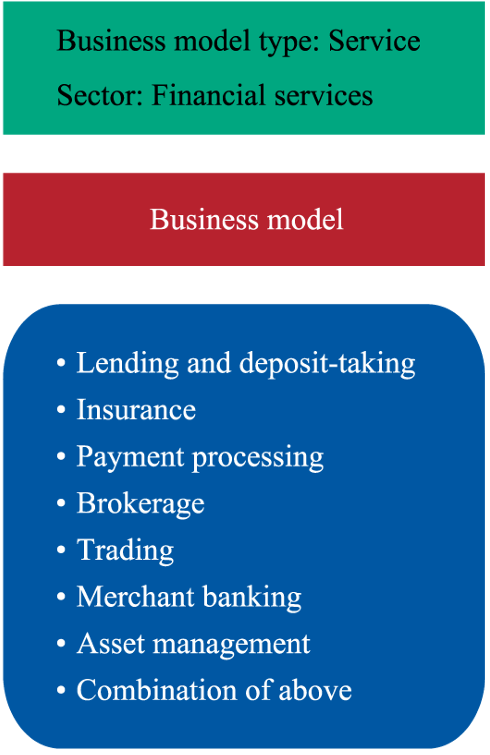
Some firms combine these models together (e.g. universal banks) while some specialize in a particular model (e.g. discount brokers).
Business Model Innovation
Digital technology has transformed the “where” and “how” elements of business models in established markets, by drastically reducing the cost of communicating, exchanging information, and transacting between businesses.
- Location matters less: Customers can easily buy from firms having no local physical presence.
- Outsourcing is easier: For similar reasons.
- Digital marketing: Makes it easy and cost-effective to reach very specific groups of customers, regardless of location.
- Network effects: Have become more powerful and accessible to firms.
Business Model Variations
There are many business model variations such as:
- Private label or “contract” manufacturers that produce goods to be marketed by others.
- Licensing arrangements in which a company will produce a product using someone else’s brand name in return for a royalty. For example, toys and apparel based on famous film characters.
- Value added resellers that not only distribute a product but also handle more complex aspects of product installation, customization, service, or support. For example, heating/air conditioning systems resellers.
- Franchise models in which distributers or retailers have a tightly defined and often exclusive relationship with the parent company.
E-Commerce Business Models
E-commerce is a broad category that includes a wide range of internet-based direct sales models.
A few key variations of e-commerce business models include:
- Affiliate marketing generates commission revenue from sales made on other people’s websites. E.g., CJ Affiliate.
- Marketplace businesses create networks of buyers and sellers without taking ownership of the goods during the process. E.g., eBay.
- Aggregators are similar to marketplaces, but they re-markets products and services under their own brand. E.g., Uber.
Network Effects and Platform Business Models
The term “network effects” refers to the increase in value of a network to its users as more people join. Many internet-based businesses are built on network effects. For example, social media, ride-sharing services, online classified etc. Network effects are also applicable to older, non-internet businesses such as telephone services, credit cards etc.
Network effects can be described as:
- Multi-sided: Applicable to two or more groups of users. For example, buyers and sellers on an online marketplace.
- One-sided: Users are a single, homogeneous group.
A platform business is defined as a business based on network effects—that is, where the value of its service or product is enhanced by the addition of customers or users.
They are different from traditional or linear businesses. With a linear business, value is added by the firm; with a platform business, value is created in the network, outside the firm.
Crowdsourcing Business Models
Crowdsourcing business models enable users to contribute directly to a product, service, or online content. For example, Wikipedia, Google Maps, Tripadvisor.
Hybrid Business Models
Some companies employ hybrid models that combine platform and traditional “linear” businesses. For example, Tesla sells cars via a linear model, but its customers benefit from an expanding network of charging stations.